


Curiosity about cosmetic injectables continues to grow, making the research phase a normal and important step before any aesthetic treatment. If you are wondering, “What is Botox?”, you are not alone. Botox is a widely recognized brand name for onabotulinumtoxinA, a highly purified neuromodulator that is administered by qualified medical professionals to temporarily relax targeted muscles and smooth the overlying skin.
Whether you are considering your first cosmetic treatment, comparing different anti-aging options, or simply looking for reliable, medically accurate information, understanding the basics is essential. This guide explains how Botox works, what ingredients are involved, and the range of cosmetic and medical uses it is commonly known for.
You will also learn about potential side effects, how Botox differs from dermal fillers, and what factors to consider when evaluating treatment providers. Having a clear understanding of these details helps you make informed decisions and approach cosmetic treatments with greater confidence.
What Is Botox?
At its core, Botox is a purified botulinum toxin type A product. Medical providers commonly inject this formulation into specific muscles to reduce dynamic wrinkles. These are the lines and creases that form when you make facial expressions, like smiling or frowning.
It is important to understand that the effects of this injectable are temporary, not permanent. Over time, the body naturally metabolizes the product, and normal muscle function gradually returns.
Many people use the term generically, but Botox is actually a specific brand name owned by Allergan. The active ingredient itself is botulinum toxin type A, which is also found in other FDA-approved brands like Dysport and Xeomin.
To learn more about specific procedures, visit our Botox treatment guide or explore options for Botox in Bangkok.
How Does Botox Work?
The mechanism of action behind this treatment is entirely neurological. When injected into a targeted area, the product blocks the release of a chemical messenger called acetylcholine at the neuromuscular junction. Without this messenger, the nerve cannot tell the muscle to contract, which temporarily relaxes the targeted muscle.
By reducing this underlying muscle movement, the overlying skin looks significantly smoother. This brings up an important distinction: Botox is specifically designed to reduce movement-related or dynamic wrinkles. It does not restore lost volume or fill in static lines that exist when your face is at rest. Dermal fillers are used for those specific volume-loss concerns.
The timeline for results is quite predictable. Muscle relaxation usually begins within 24 to 72 hours after injection. The results typically peak at the one- to two-week mark. For most patients, the visible cosmetic effects last anywhere from 3 to 4 months. To understand the early stages better, you can review the article,” When Does Botox Kick In? A Day-by-Day Timeline.”
Further information on the complete treatment process is available in these related articles:
- How long does Botox take to work
- How long Botox lasts
- How often Should You Get Botox
- Botox vs filler breakdown
What Is Botox Made Of?
Have you ever wondered exactly what Botox is made of? The primary active ingredient is purified botulinum toxin type A. While the word “toxin” can sound intimidating, the medical formulation used in cosmetic clinics is highly diluted, purified, and heavily regulated. The manufacturing process stabilizes the protein, ensuring it is safe for therapeutic and cosmetic use when administered by a trained medical professional.
It is also important to address common myths surrounding the ingredients. The product is not made from snake venom, nor is it an animal-derived product in the way many internet rumors mistakenly suggest. It is a carefully synthesized biologic medication manufactured in sterile laboratory environments.
What Is Botox Used For?
This versatile medication serves two main purposes: cosmetic enhancements and medical therapies.
Cosmetic Uses of Botox
Aesthetic providers use this treatment to soften dynamic wrinkles across the face. The FDA has officially approved it for treating:
- Glabellar lines (the frown lines or “11s” between the eyebrows)
- Lateral canthal lines (crow’s feet around the eyes)
- Forehead lines
Additionally, highly trained injectors frequently use the product for common off-label cosmetic purposes. These include masseter slimming to narrow the lower face, the lip flip to subtly enhance the upper lip, bunny lines on the nose, and smoothing prominent neck bands.
Medical Uses of Botox
Beyond aesthetics, this neuromodulator has powerful therapeutic applications. Medical professionals utilize it to treat chronic migraines, primary axillary hyperhidrosis (excessive underarm sweating), overactive bladder, and cervical dystonia (severe neck muscle spasms).
For specific treatment deep-dives, explore our pages on Masseter Botox and Botox for migraines.
What Is Botox Used For on the Face?
Facial anatomy is complex, and skilled injectors can target various muscle groups to achieve specific aesthetic goals. Here is a breakdown of common facial treatment areas:
- Forehead lines: Targets the frontalis muscle to smooth horizontal creases that appear when you raise your eyebrows.
- Frown lines (11s): Relaxes the procerus and corrugator muscles to soften the deep vertical lines between the brows.
- Crow’s feet: Softens the fine lines that fan out from the outer corners of the eyes when smiling or squinting.
- Bunny lines: Reduces the diagonal wrinkles that appear on the bridge of the nose when you scrunch it.
- Masseter/Jawline: Relaxes the strong chewing muscles to alleviate teeth grinding and create a slimmer, V-shaped lower face.
- Chin dimpling: Smooths the mentalis muscle to prevent a “pebbled” or “orange peel” texture on the chin.
- Lip flip: Relaxes the muscles around the upper lip, allowing it to subtly roll outward for a slightly fuller appearance without adding volume.
- Neck bands: Softens the platysma muscle cords that become prominent with age, creating a smoother neck contour.
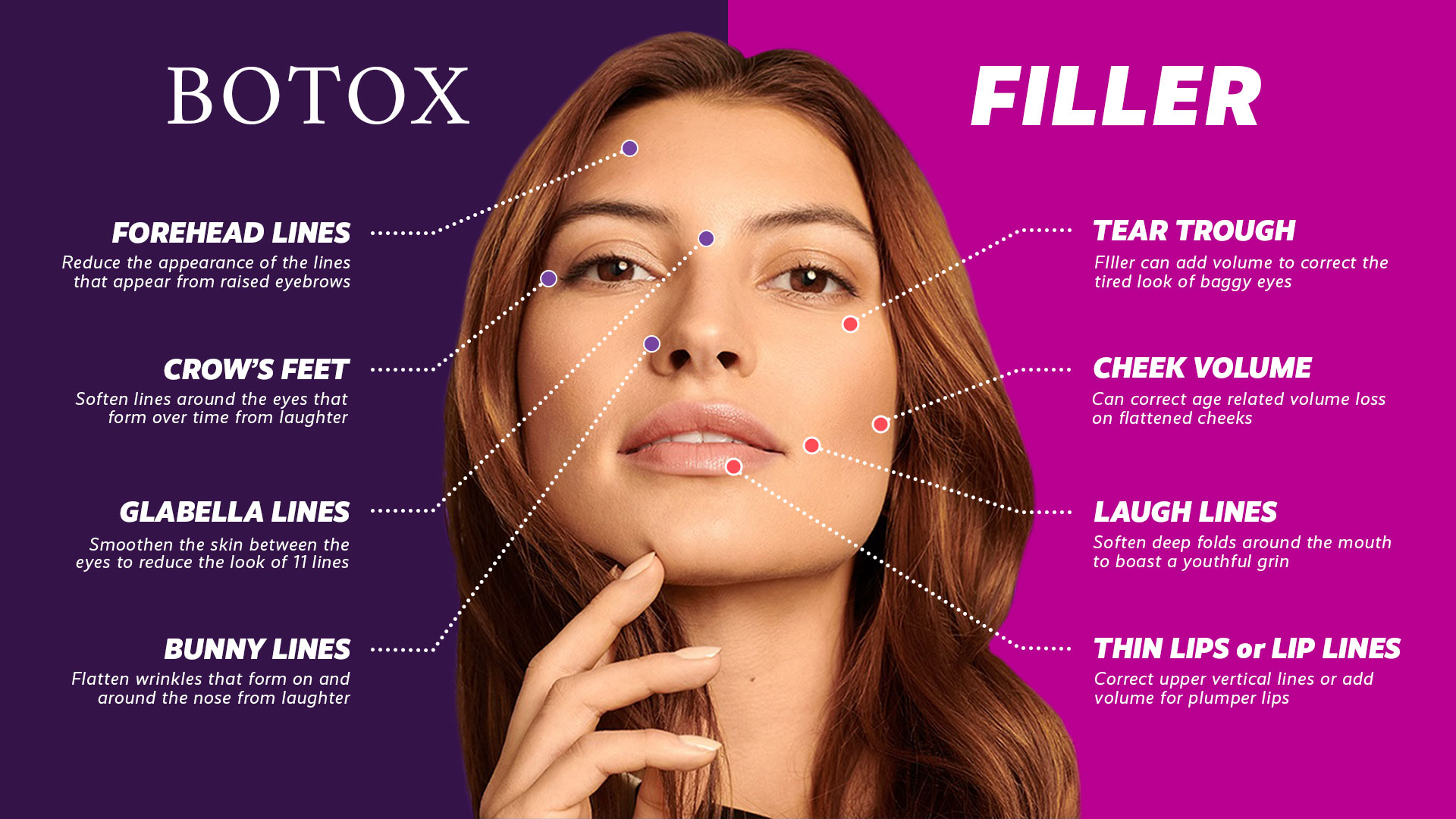
Botox vs Fillers: What’s the Difference?
Patients frequently confuse these two popular injectables, but they serve entirely different purposes. Botox relaxes muscles to smooth out expression lines. Dermal fillers use gel-like substances (typically hyaluronic acid) to physically add volume beneath the skin, plumping lips, cheeks, and deep static folds.
| Feature | Botox & Neuromodulators | Dermal Fillers |
| Purpose | Relaxes overactive facial muscles | Restores lost volume and plumps skin |
| How it works | Blocks nerve signals to stop muscle contraction | Physically fills space beneath the skin |
| Common areas | Forehead, between brows, crow’s feet, masseters | Lips, cheeks, under eyes, nasolabial folds |
| Result type | Smoother skin during facial expressions | Plumper, more contoured facial structure |
| Duration style | Gradually wears off over 3 to 4 months | Breaks down naturally over 6 to 18+ months |
Comprehensive anti-aging plans often use both treatments in harmony to address both muscle-driven wrinkles and age-related volume loss. Read our full Botox vs filler article.
Is Botox Surgery?
There is a widespread misconception that cosmetic injectables require surgical intervention. Botox is strictly a non-surgical, minimally invasive treatment. There is no cutting, no general anesthesia, and no incisions involved in the procedure. Because the treatment relies entirely on tiny injections with ultra-fine needles, the downtime is minimal compared to cosmetic surgery. Most patients return to their normal daily activities immediately after their appointment.
How Is Botox Measured?
Unlike liquids that are measured in milliliters (ml), Botox is dosed and priced in “units.” A unit is a specific measurement of the biologic activity of the botulinum toxin.
The number of units required for a successful treatment varies heavily based on several factors. Muscle strength, biological sex, individual metabolism, and the specific area being treated all influence the final dosage. Men typically require more units than women due to larger muscle mass.
It is vital to remember that more units do not automatically equate to better results. A tailored, conservative approach is often the best way to achieve a natural, refreshed look without appearing “frozen.”
Learn more about dosing by visiting Botox units explained, How much Botox per unit, and Forehead Botox units.
Botox Side Effects and Safety
When performed by a qualified medical professional, this treatment has a strong safety profile. However, as with any medical procedure, there are potential side effects to consider. Common, short-term side effects include mild injection-site pain, redness, localized swelling, minor bruising, and occasional headaches. These typically resolve on their own within a few days.
Technique-related risks highlight the importance of choosing an experienced injector. Improper placement or incorrect dosing can lead to temporary aesthetic issues such as ptosis (a droopy eyelid or brow), facial asymmetry, or an overactive lateral brow (often called a “Spock brow”).
While exceptionally rare in standard cosmetic applications, serious risks do exist. These include the unintended spread of the toxin to surrounding areas, which can cause muscle weakness, swallowing difficulties, or breathing issues. This is why thoroughly informed consent and choosing a highly trained, board-certified medical injector are absolutely crucial to mitigate risks.
For post-treatment guidance, review What not to do after Botox and information on Droopy eyelid after Botox.
Common Botox Myths and Misconceptions
Misinformation about cosmetic injectables is common online. Here are a few persistent myths that need correcting:
- Is Botox poison?
While derived from a botulinum toxin, the medical product is highly purified, strictly regulated, and administered in extremely tiny, safe doses that do not cause botulism. - Is it a filler?
No. It relaxes muscles, whereas fillers add physical volume to the face. - Is it made from snake venom?
Absolutely not. This is an internet myth with no basis in medical science. - Is “hair Botox” the same thing?
No. Hair Botox is a marketing term for a deep conditioning hair treatment. It contains no botulinum toxin and involves no needles. - What about “Botox in a bottle”?
Topical serums marketed with this phrase use peptides (like Argireline) to hydrate and slightly firm the skin. They cannot penetrate deeply enough to block nerve signals and do not replicate the results of an injectable neuromodulator.
What to Know Before Getting Botox
Preparation and research are key to a successful treatment. Always prioritize choosing a qualified, licensed medical provider over finding the cheapest deal. During your consultation, clearly discuss your aesthetic goals, and ensure you disclose your full medical history, including any medications or supplements you take.
Expect to discuss cost structures, as clinics may charge per unit or per facial area. Your provider will also outline standard aftercare rules, such as remaining upright for a few hours and avoiding heavy cardiovascular exercise for the rest of the day to prevent the product from migrating.
Learn more about financial expectations on our How much Botox costs?.
Find Botox Clinics in Thailand
Thailand has established itself as a premier global destination for high-quality, safe, and cost-effective cosmetic treatments. With internationally accredited facilities and highly trained medical professionals, patients can access world-class aesthetic care.
If you are ready to transition and want to research or book the clinics, explore our curated directories:
- Botox clinics in Bangkok
- Botox clinics in Chiang Mai
- Botox clinics in Phuket
- Botox clinics in Chon Buri

Taking the Next Step in Your Cosmetic Journey
Understanding the science, safety, and applications of cosmetic injectables is the best way to ensure a positive aesthetic experience. Botox remains a highly effective, safe, and temporary non-surgical option for treating dynamic wrinkles and specific medical conditions, provided it is administered by a qualified professional.
With a clearer understanding of how the treatment works, how it compares to fillers, and what to expect for cost and aftercare, you are in a good position to consult with a qualified provider. Doodeena can help you find verified clinics and connect with professionals for further discussion.
Frequently Asked Questions (FAQ)
What is Botox and fillers?
Patients often confuse neurotoxins and dermal fillers, but they serve entirely different purposes. Neurotoxins relax the underlying muscle to smooth out dynamic wrinkles. Dermal fillers are gel-like substances injected beneath the skin to restore lost volume, plump the lips, and fill in deep, static creases.
Is Botox preventative?
Yes, preventative treatments are highly popular. Younger patients in their mid-to-late twenties often use low doses to stop repetitive facial movements. By limiting these movements early, they prevent deep, etched-in wrinkles from forming in the first place.
What is “Baby Botox”?
“Baby Botox” refers to the technique of micro-dosing. The provider injects smaller amounts of the neurotoxin across the target area. This approach delivers softer, more subtle results that smooth fine lines while maintaining a high degree of natural facial movement.