



According to the American Society of Plastic Surgeons (ASPS), botulinum toxin type A injections consistently rank as the top minimally invasive cosmetic procedure year after year. Millions of people seek out this treatment to refresh their appearance, soften expression lines, and maintain a youthful glow. Yet, despite its massive popularity, a surprising amount of mystery still surrounds the procedure.
Many people are curious about aesthetic treatments or “prejuvenation” but hold back due to a few common fears. Perhaps you are confused about the difference between Botox and dermal fillers. Maybe you are worried about ending up with a “frozen” face that lacks natural expression. These concerns are entirely normal, especially when navigating the medical tourism landscape in places like Bangkok or Phuket, where finding a trusted, English-speaking clinic is a top priority.
The goal of this article is to demystify the treatment by explaining exactly: how does Botox work in the body? When you understand the underlying biology, the procedure feels much less intimidating and far more predictable.
We will walk you through the underlying science of the treatment, the exact timeline for seeing your desired results, and the crucial difference between treating facial wrinkles versus medical conditions like chronic migraines. Finally, we will explore what to do if a treatment simply does not meet your expectations, equipping you with the knowledge you need to make safe, confident decisions for your skin.
What Actually is Botox?
To understand the treatment, we first need to define what we are actually putting into the skin. Botox is a highly purified biologic and prescription medication technically known as onabotulinumtoxinA. It is derived from botulinum toxin type A, a neurotoxin that has been safely adapted for medical and cosmetic use.
One of the most common points of confusion for patients is the difference between this treatment and dermal fillers. Do they do the same thing? The short answer is no. A simple rule of thumb favored by leading aesthetics experts is: “Botox relaxes, fillers restore.” Dermal fillers are made of gel-like substances (often hyaluronic acid) designed to physically add volume to hollow areas, plump the lips, or lift the cheeks. Botox, on the other hand, temporarily prevents specific muscle contractions. It does not fill anything; it simply stops the movement that causes skin to fold.
It is also important to note that while “Botox” is often used as a catch-all term for wrinkle relaxers, it is actually a specific brand name owned by Allergan. Today, there are several other FDA-approved formulations of botulinum toxin type A available at top clinics, including Dysport (abobotulinumtoxinA), Xeomin (incobotulinumtoxinA), and Jeuveau (prabotulinumtoxinA-xvfs). While they share the same core mechanism, they behave slightly differently in terms of unit dosing, diffusion, and onset time.
The Science: How Does Botox Work?
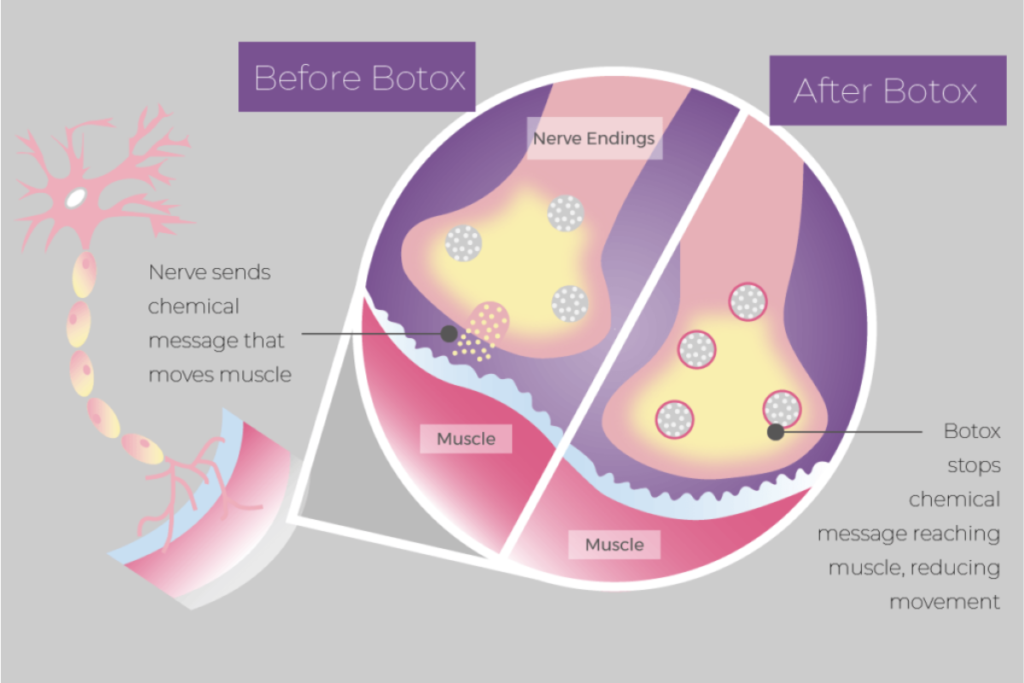
When we look beneath the surface of the skin, the human body operates through an incredibly complex network of electrical and chemical signals. So, at a cellular level, how does Botox work? It all comes down to a tiny intersection in the body called the neuromuscular junction.
Under normal circumstances, your brain sends a message down your nerves whenever you want to move a muscle. When that signal reaches the end of the nerve, it releases a chemical neurotransmitter called acetylcholine. This chemical crosses the gap between the nerve and the muscle, telling the muscle to contract. This is the process that allows you to smile, frown, or raise your eyebrows in surprise.
Botox effectively acts as a microscopic roadblock at this junction. When it is injected into a specific target muscle, the toxin binds to the nerve endings. It then cleaves specific proteins—most notably one called SNAP-25. Without intact SNAP-25 proteins, the nerve is physically unable to release acetylcholine. Because the chemical signal never reaches the muscle, the muscle simply does not receive the command to move.
Dermatologists often describe this effect as “relaxing” the muscle, but biologically, it is a temporary “chemical denervation.” The nerve is silenced. Crucially, this is not a permanent paralysis. Over a period of several months, the nerve endings naturally sprout new connections and recover, gradually restoring the muscle’s ability to contract.
How Does Botox Work for Wrinkles?
Now that we understand the microscopic roadblocks, how does this translate to a smoother complexion? When patients ask, “how does Botox work for wrinkles?,”the answer lies in the mechanical stress placed on our skin.
Every time a facial muscle contracts, it pulls and folds the overlying skin. Over thousands of repetitive movements, these temporary folds eventually begin to leave lasting marks. By selectively blocking the nerve signals to specific facial muscles, we stop the skin from continuously folding. When the skin is given a break from this constant mechanical stress, it has the opportunity to smooth out and remodel superficially.
Call-Out Box: Dynamic vs. Static Wrinkles
To get the best results from your treatment, you need to know which type of wrinkle you are dealing with:
* Dynamic Wrinkles: These are formed by repeated muscle movements, such as frowning, squinting, or raising your eyebrows. They are most visible when your face is in motion. Botox is highly effective at treating dynamic wrinkles.
* Static Wrinkles: These are lines that remain visible even when your face is completely at rest. They are caused by natural aging, volume loss, sun damage, and repeated creasing over many years. While a neuromodulator can soften these lines indirectly over time, it will not erase them entirely without the addition of dermal fillers or skin resurfacing treatments.
A great example of this process is the upper face. How does Botox work on forehead lines? Your injector will carefully place small amounts of the medication into the frontalis muscle—the large muscle responsible for lifting your eyebrows. By relaxing the frontalis, the horizontal lines across your forehead cannot be actively crinkled. This gives the skin time to smooth out and prevents those lines from deepening into permanent static wrinkles.
Where Does Botox Work Best?
Because acetylcholine signaling drives a wide variety of bodily functions, this biologic medication is incredibly versatile. It is used to treat everything from cosmetic concerns to debilitating pain.
Cosmetic Applications
The most common aesthetic areas treated are located in the upper third of the face. These include the glabellar lines (the vertical “11s” that form between the eyebrows when you scowl), the horizontal lines across the forehead, and the lateral canthal lines, universally known as crow’s feet.
However, advanced injectors also utilize this medication for the lower face. Patients frequently ask**, “how does masseter Botox work?” or “how does jaw Botox work?” The masseter is a thick, powerful muscle located at the angle of the jaw, primarily used for chewing. In many people, chronic teeth grinding or clenching (TMJ) causes this muscle to become overworked and enlarged. By carefully injecting the masseter muscle, the tension and pain associated with teeth grinding are significantly alleviated. As an added cosmetic benefit, relaxing this enlarged muscle gradually causes it to shrink, resulting in a beautifully slimmed, contoured lower face.
Medical Applications
Beyond aesthetics, this treatment offers profound relief for several medical conditions. For individuals suffering from chronic, debilitating headaches, how does Botox work for migraines? When injected into specific pain networks around the head and neck, it prevents the activation of pain pathways, stopping migraines before they even start.
Additionally, it is a highly effective treatment for primary axillary hyperhidrosis (severe underarm sweating) by blocking the chemical signals that stimulate the sweat glands. It is also utilized heavily in neurology to treat severe muscle spasticity and cervical dystonia, proving that its applications stretch far beyond simple cosmetic enhancement.
The Timeline: How Long Until Botox Works?
One of the most common anxieties for first-time patients revolves around timing. You have done your research, you have visited a verified clinic, and you have received your injections. Now you are looking in the mirror and wondering, “how long until Botox works?“ Or perhaps you have a big event coming up and need to know exactly: “how fast does Botox work?“
Unlike dermal fillers, which provide instant volume, neuromodulators require a little bit of patience. The proteins need time to bind to the nerve terminals and block those chemical signals. Here is a clear, chronological breakdown of what you can expect:
- Days 3 to 5 (Initial Onset): This is when the magic begins. You will likely start to feel a slight heaviness in the treated areas, accompanied by a noticeable reduction in muscle movement.
- Days 10 to 14 (Peak Effect): By the two-week mark, the medication has fully integrated into the neuromuscular junction. This is when the final, maximum result of the treatment is visible. Your skin will look its smoothest, and the targeted muscles will be fully relaxed.
- Months 3 to 4 (Duration): How long does Botox work for? For the vast majority of patients, the effects last between three to four months. As the weeks pass, the nerve endings will naturally begin to recover, and muscle function will gradually return to normal.

Why Isn’t My Botox Working?
Occasionally, a patient will look in the mirror two weeks after an appointment and search the internet for “why isn’t my Botox working?” or “why didn’t my Botox work this time?” It can be incredibly frustrating to invest in a treatment and not see the desired outcome.
If you find yourself in this position, there are a few common reasons for sub-optimal results:
- Under-Dosing or Anatomy: Every face is unique. The injected dose may have simply been too low for the strength of your specific facial muscles. Alternatively, the injection mapping may have slightly missed the target pattern required to fully relax your unique muscular anatomy. A quick follow-up appointment with your injector can usually correct this with a few additional units.
- Static vs. Dynamic Wrinkles: Remember the rule from earlier. If a wrinkle is deeply etched into the skin even when your face is at rest (a static wrinkle), blocking the muscle movement will not make the line completely disappear. You may need to pair your neuromodulator with a dermal filler or a skin-resurfacing laser to achieve a flawless finish.
- True Resistance: While incredibly rare at cosmetic doses, it is biologically possible to develop true immunogenic resistance. Over time, particularly with frequent, high-dose treatments, some bodies can develop neutralizing antibodies that fight off the toxin, rendering it ineffective.
Your Next Step Toward Smoother Skin
At its core, Botox is a safe, temporary muscle relaxer that blocks specific nerve signals to smooth out dynamic wrinkles. It is not a filler, it does not permanently freeze your face, and it requires just a little bit of patience to see the full, glowing results. By understanding the biology behind the injections, you can approach your aesthetic journey with confidence and clear expectations.
Are you ready to stop guessing and start planning your treatment? The key to natural, beautiful results is finding a qualified, board-certified injector who understands facial anatomy and prioritizes your safety. Explore Doodeena to connect top-rated, English-speaking beauty clinics across Thailand. Book a consultation today to receive a personalized facial assessment and discuss your specific aesthetic goals with a verified professional.